
Tailored to your company. Forms, processes, calculations and reporting are agreed around your requirements.
TAILOR-MADE MARITIME SOFTWARE
Shipping agency software.
Built around your agency.
A practical agency program should connect the information your team uses every day: the vessel, the port call, the parties, the documents and the account. 7SeasDesk is tailored around that workflow.
Discuss your solution ↗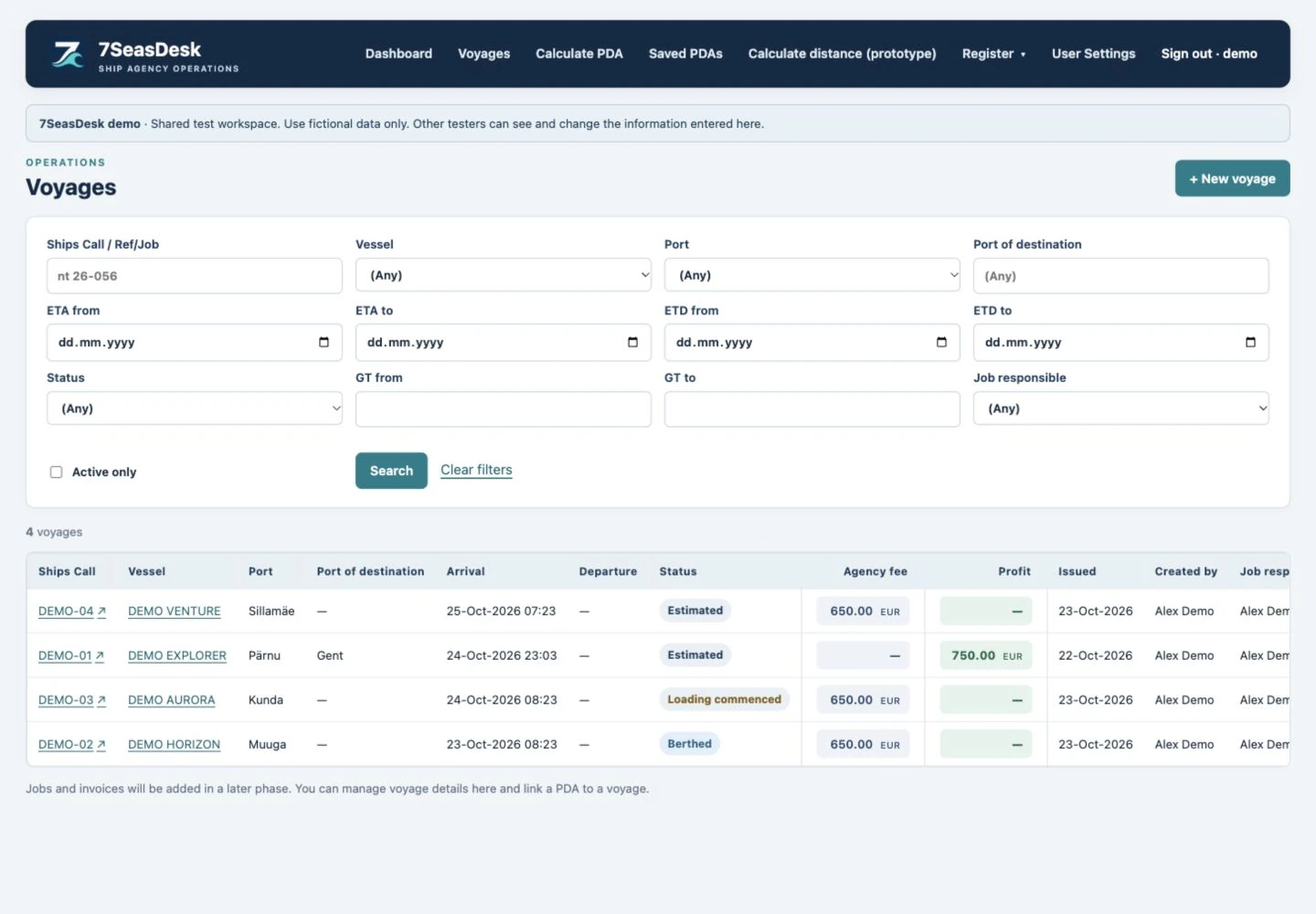
What should a shipping agency program include?
A port agency handles the same vessel information in many places. A nomination starts the call; the master supplies particulars; the terminal needs cargo instructions; the owner needs a cost estimate. Later, actual events, supplier evidence and the final account must agree. Re-entering those facts across separate files creates work at every handover.
7SeasDesk brings that onshore agency work into a shared port-call workspace. Save vessel and company records, assign a responsible agent, prepare the estimate and carry confirmed information into the operational documents. The configuration is agreed around the forms and processes your agency actually uses.
From the first PDA to the final disbursement account
Prepare a Proforma Disbursement Account using the vessel particulars and the relevant port tariff rules. Review the calculation basis, agreed agency fee, optional services and customer-specific adjustments before sending the estimate. Keep internal costs and customer sales distinct.
When the call progresses, record actual charges and supporting evidence for the FDA. A consistent connection between the estimate and the final account helps the team explain a difference instead of searching through unrelated spreadsheets. Explore the PDA and FDA software workflow.
One source for operational documents
Vessel name, IMO, master, companies, terminal, dates and cargo quantities can be reused across the documents that require them. Multiple Bills of Lading and cargo parcels remain identifiable. Terminal instructions and cargo documents should retain each product with its correct quantity and unit.
Your document layouts are part of the setup. We review the supplied forms, editable fields, standard wording and PDF outputs with your team. Read about cargo document preparation and the Statement of Facts.
A handover the next agent can follow
A shared call register makes the vessel, port, expected dates and responsible agent visible in one place. Operational events and notes remain attached to the call. The next person can continue from saved information rather than reconstructing the history from messages and local files.
Access, working roles and reports are configured around your organisation. For a new office or port, agree its tariff coverage, document wording and reporting needs during onboarding. Local rules need to be reviewed before they become calculation defaults.
Tailor-made software for your agency
Bring a representative port call, a PDA, an FDA and the documents your agents prepare. Include a difficult example: two cargoes, a changed sailing date or a charge that differs from the estimate. This provides a concrete basis for defining the software requirements.
We use that example to agree the workflow, forms, calculations, users and deployment scope, then test the result with your team. Discuss your shipping agency software and the parts of your current process you want to improve.
Software for port agents: a practical acceptance checklist
A demonstration is most useful when your agents can follow one complete call. Use this checklist when comparing a replacement for separate spreadsheets and document folders:
- Reuse the vessel particulars. Open a second call for the same vessel and check which facts are reused and which remain specific to the visit.
- Trace an estimate to its final account. Review the saved tariff basis, internal cost, customer charge and supplier evidence. An edited final charge should remain explainable.
- Print a difficult SOF. Try several cargo parcels, a shared cargo description and enough events to require continuation pages. Check the weights, units, page count and signing spaces.
- Check a second invoice recipient. Confirm that a separate FDA can have its own reference and charges without duplicating the original account.
- Agree the operating arrangement. Document who manages hosting, user access, backups, template changes and support before rollout.
Bring your existing forms to a workflow demonstration. We use the example to agree acceptance checks for your configuration, rather than treating a generic feature list as the finished specification.
Turn the demo into a practical review
Use the 24-point software requirements checklist to set priorities and export the acceptance checks you want to discuss.
Questions about shipping agency software
Is this software for shipping agencies or vessel operators?
The core workspace supports port agency operations. A vessel operator can use the same call information for onshore coordination, with the users, workflows and reports agreed for that organisation.
Can our existing document formats be used?
Document formats and standard wording are reviewed as part of the tailored setup. The agreed forms are checked in the generated PDF outputs before rollout.
Does one agency program cover every port tariff automatically?
Port and terminal tariff coverage must be agreed and validated. Your team reviews the applicable rates, conditions and any manually entered services before issuing a PDA or FDA.
Let your workflow shape the solution.
Bring your forms, ports, calculations and handovers. We will review an example configuration and agree the scope around your organisation.
Discuss your solution ↗