
Tailored to your agency. These workflows are examples of what we can build around your documents, processes, tariff rules and reporting requirements. Explore tailor-made solutions ↗
TANKER OPERATIONS, CONNECTED
Tanker port agency software.
Every parcel in context.
A tanker call can involve several cargoes, separate Bills of Lading and different terminal requirements. 7SeasDesk keeps the vessel, cargo lines, operational events and disbursement accounts in one shared port call.
Discuss your solution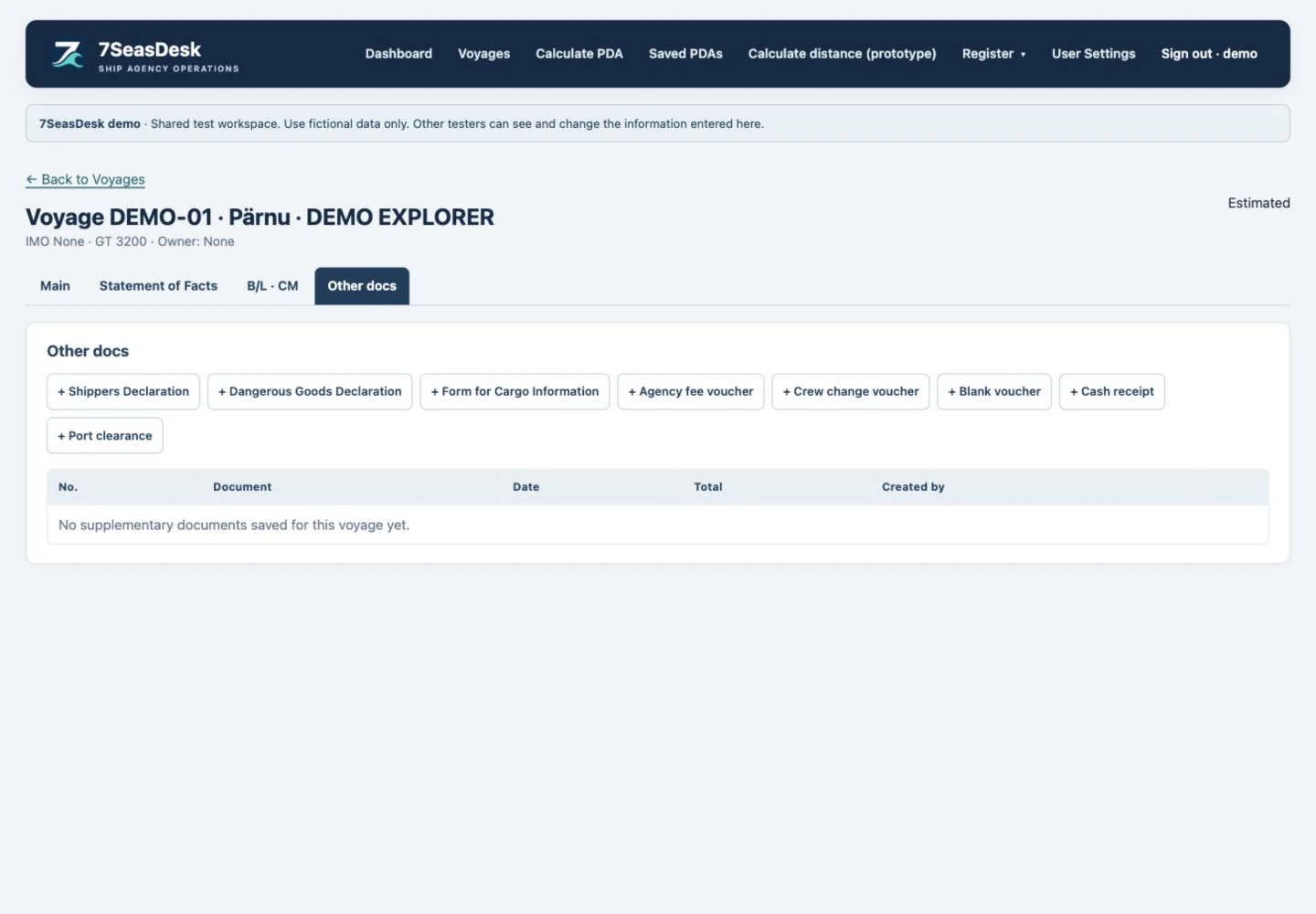
One vessel, more than one cargo
A single port call does not always mean a single parcel. A tanker may discharge two products, carry several Bills of Lading or complete one parcel before starting the next. The product, quantity and unit need to stay connected throughout the documents.
In 7SeasDesk, add separate cargo lines under one B/L or create additional B/Ls within the same call. Keep each product with its own quantity. Select the appropriate metric-ton basis, VAC or AIR, for the cargo line rather than relying on an unexplained combined total.
Terminal notifications and loading or discharging requests can print the cargoes on separate rows. The Statement of Facts can show each product followed by its own weight in a compact header. Review the selected B/Ls and quantities before issuing the final documents.
A Statement of Facts for the actual sequence of work
Keep commencement and completion events for each cargo operation. When several parcels are handled, the overall call can retain the first commencement and last completion while the SOF preserves the individual operational times.
Use saved operation wording, adjust descriptions when needed and move rows to match the sequence of the call. Enter a single time or a time range. Repeated dates need not be printed on every line, and longer statements continue onto numbered pages with the final remarks and signing areas at the end.
Explore the Statement of Facts workflow and review your terminal wording in a guided demonstration.
Terminal documents built from shared call information
Vessel particulars, the master, owner or operator, terminal and sailing date should not have to be retyped for every form. Enter shared information in the call and use it across the configured document set.
Available forms include the master’s questionnaire, terminal notification, loading and discharging requests, Bills of Lading, cargo manifests, Port Clearance, Customer Evaluation Questionnaire and a waste reception form. The available layouts are agreed during setup; a form that suits one terminal is not automatically the correct form for another.
Preview the PDF with a realistic example, including long owner names and more than one cargo. This is where the team can check signatures, quantities, dates and the retained document layout before using it operationally.
Keep port and terminal charges understandable
Prepare the PDA and reconcile the FDA alongside the call. Vessel GT and RGT, the operation, stay and configured conditions can affect individual charges. The relevant basis depends on the charge and the agreed tariff, so it should remain visible and reviewable.
Keep cost and sales lines separate, reuse an agreed agency fee and attach supporting invoices to the relevant FDA rows. Existing saved account amounts are retained when tariffs are updated later.
Port coverage and terminal rules are configured for the agency. We review those requirements during onboarding rather than assuming one tariff table works across every port or country.
What to bring to a tanker agency demo
- A representative port call with one or more cargo parcels.
- The B/L structure, quantities and units your team uses.
- Your terminal notification, request and SOF examples.
- The port and terminal charges you need to estimate and reconcile.
- The approval and handover steps between agents and accounting.
We use fictional sample data for the demonstration. Your own document formats and tariff coverage can then be reviewed as part of an agreed setup.
SEE IT WITH A REALISTIC PORT CALL
Let your workflow shape the solution.
Tell us about your agency, forms, ports and handovers. We will review an example configuration and define what your tailored solution needs to support.
Discuss your solution